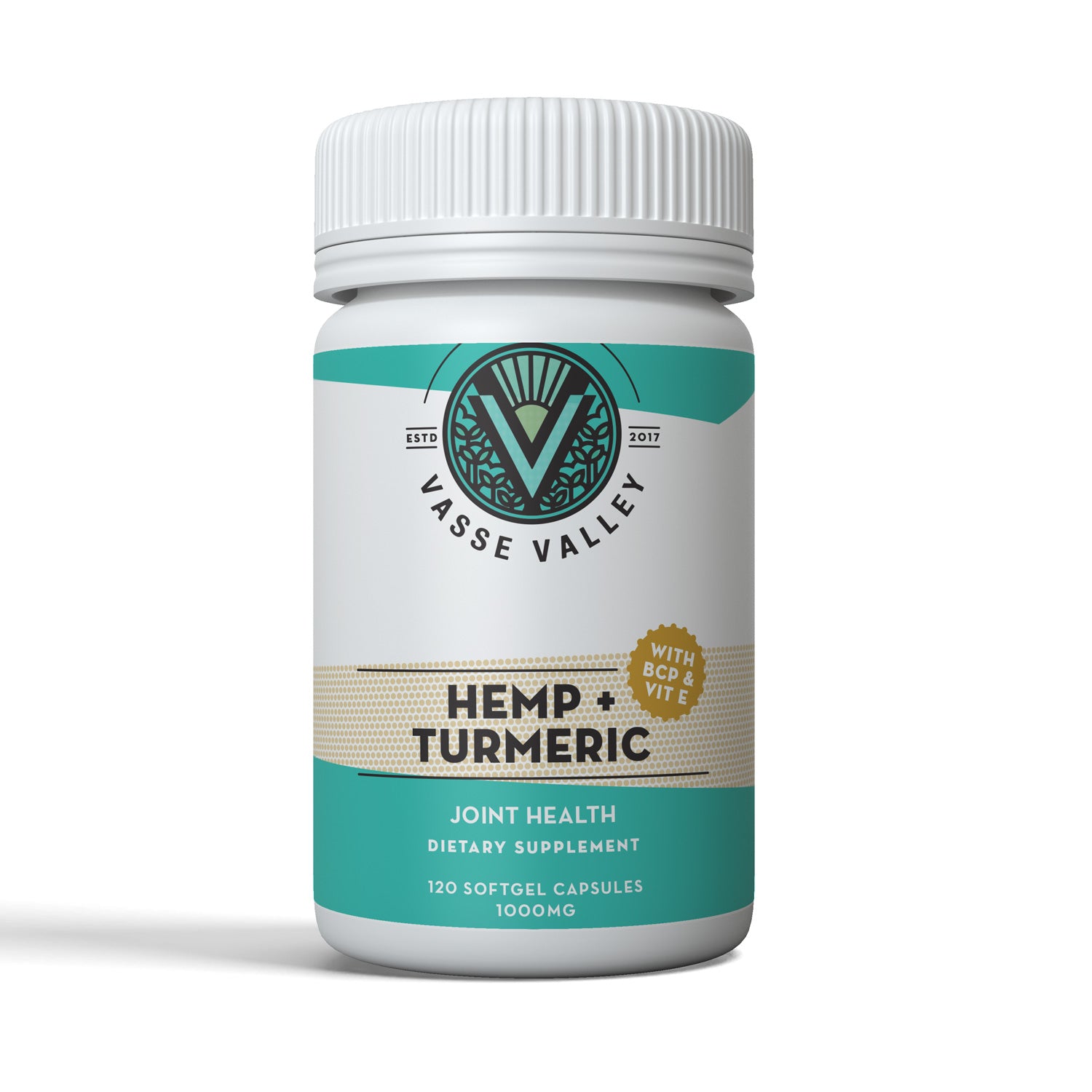


If you've looked at a turmeric supplement before, you may have noticed that many contain black pepper extract, usually in the form of a compound called piperine.
So why don't we add black pepper to our Hemp & Turmeric Capsules?
The short answer is that we've chosen a different approach to supporting turmeric absorption: we combine turmeric with hemp seed oil.
There is good science behind both approaches, but they work in quite different ways. Here's why we chose oil rather than black pepper.
Why does turmeric need help with absorption?
Turmeric contains a group of naturally occurring compounds called curcuminoids, of which curcumin is the best known.
Curcumin has attracted considerable scientific interest, but it has one significant challenge: it is poorly soluble in water and isn't absorbed particularly efficiently from the digestive tract.
Once absorbed, curcumin is also rapidly broken down and modified by the body. This combination of poor absorption and rapid metabolism is why scientists often describe curcumin as having low oral "bioavailability" – essentially, how much of a substance becomes available to the body after we consume it [1–3].
This has led researchers to investigate different ways of improving curcumin absorption.
Why is oil helpful?
Curcumin is fat-soluble, meaning it behaves differently from water-soluble substances during digestion.
When we eat fat, our digestive system releases bile and digestive enzymes. The fat is broken down and incorporated into tiny structures called micelles. These help fat-soluble compounds become dispersed in the watery environment of the digestive tract, making it easier for them to come into contact with the cells lining the intestine and be absorbed.
The same principle can apply to curcuminoids.
So, rather than adding another ingredient to change the way the body processes curcumin, we use an oil-based formulation that works with the body's normal fat-digestion and absorption processes.
Importantly, simply adding any oil to turmeric doesn't automatically make it highly bioavailable. The type and amount of oil, the form of turmeric and the overall formulation all matter.
However, human research supports the idea that appropriately designed lipid-based formulations can increase curcuminoid exposure.
In a 2024 randomised crossover study, 12 healthy adults received either a curcuminoid extract on its own or the same extract formulated with oil and phospholipids. The oil-based formulation produced approximately 1.9 times greater exposure to total curcuminoids and 3.3 times greater exposure to tetrahydrocurcumin, a major curcumin metabolite [4].
This doesn't mean that every oil-based turmeric product will behave in exactly the same way. But it provides human evidence that the right lipid formulation can make a difference to the way curcuminoids are absorbed.
What does black pepper do?
Black pepper contains a compound called piperine, which has been studied as a "bioenhancer" – a substance that can increase the amount of another compound that reaches the bloodstream.
This is why turmeric and black pepper are so often paired together in supplements.
The classic study behind this combination was published in 1998. Researchers gave healthy volunteers 2 g of curcumin, either alone or with 20 mg of piperine. They reported a very large increase in the measured bioavailability of curcumin when piperine was included [5].
This is where the often-repeated claim that black pepper makes curcumin "2,000% more bioavailable" comes from.
But there's more to the story.
Piperine doesn't simply help curcumin dissolve. Research suggests that it can interfere with some of the enzymes and transport systems involved in the body's normal processing of compounds, including curcumin [6].
In simple terms:
Oil helps create an environment that supports the absorption of a fat-soluble compound.
Piperine can increase curcumin exposure partly by changing some of the processes that normally metabolise and transport it.
These are two quite different approaches.
Is black pepper better?
Not necessarily.
The original piperine study was important, but it was a small study using a relatively high dose of curcumin and piperine.
As curcumin research has developed, scientists have also found that measuring "bioavailability" is more complicated than it first appears. Curcumin is rapidly converted into other compounds, and different studies measure different forms of curcumin and its metabolites.
This makes it difficult to directly compare the results of different formulations.
A particularly interesting 2025 independent human study compared several commercially available curcumin formulations, including one with piperine. The researchers found that levels of unchanged ("free") curcumin in the blood remained very low, and, in their study, adding piperine did not increase systemic exposure to free curcumin [7].
This doesn't prove that piperine never affects curcumin absorption. There is evidence that it can increase measured exposure under some circumstances.
Rather, it shows why the frequently quoted "2,000%" figure shouldn't be interpreted as meaning that every turmeric supplement containing black pepper will deliver 20 times more active curcumin to the body.
The science is more nuanced than that.
What about the omega-3 in hemp seed oil?
There's another reason we like hemp seed oil as part of this formulation.
Hemp seed oil naturally contains alpha-linolenic acid (ALA), an essential omega-3 fatty acid, as well as omega-6 fatty acids. Hemp seed oils typically contain around 10–20% ALA, although the exact composition varies with the hemp variety and growing conditions [8,9].
Omega-3 fatty acids are important components of cell membranes and are involved in a range of biological processes. ALA can also be converted by the body into the longer-chain omega-3 fatty acids EPA and DHA.
So we see the two ingredients as complementary: the hemp seed oil provides a source of essential fatty acids while also providing the lipid environment needed to absorb a fat-soluble ingredient such as turmeric.

Why don't we use piperine?
For Vasse Valley, the decision comes down to our formulation philosophy.
We don't believe that adding an ingredient simply because it increases a blood concentration is necessarily the best approach.
Instead, we've chosen to combine turmeric with hemp seed oil because curcuminoids are fat-soluble and lipid-based digestion provides a natural pathway for supporting their absorption.
We're therefore using the properties of turmeric and the body's normal processes for digesting dietary fats, rather than deliberately adding piperine to influence metabolic pathways.
There's another consideration, too.
Because piperine can affect enzymes and transport proteins involved in the metabolism of other substances, researchers have raised the possibility that it may interact with some medicines [6]. The significance of these interactions depends on the particular medicine, dose and individual circumstances.
This doesn't mean that black pepper is unsafe. Black pepper is a normal food and has a long history of culinary use.
But when formulating a concentrated supplement, we believe it's worth asking whether an additional ingredient is necessary and what biological processes it influences.
The bottom line
There isn't a single formulation that can currently be described as the universally "best" way to deliver turmeric.
What the research does tell us is that curcumin is poorly water-soluble, that dietary lipids can support the absorption of fat-soluble compounds, and that appropriately designed lipid-based formulations can increase curcuminoid exposure.
For Vasse Valley, we've chosen the simpler approach: turmeric combined with hemp seed oil, without added black pepper.
We haven't left the black pepper out by accident.
We've left it out deliberately, because we believe an oil-based formulation is a sensible way to support the absorption of turmeric while keeping our ingredient list purposeful and straightforward.
References
- Anand P, Kunnumakkara AB, Newman RA, Aggarwal BB. Bioavailability of curcumin: problems and promises. Molecular Pharmaceutics. 2007;4(6):807–818. doi:10.1021/mp700113r.
- Sharma RA, Gescher AJ, Steward WP. Curcumin: the story so far. European Journal of Cancer. 2005;41(13):1955–1968.
- Tabanelli R, Brogi S, Calderone V. Improving curcumin bioavailability: current strategies and future perspectives. Pharmaceutics. 2021;13(10):1715.
- Wagner T, Wacker R, Klein T, Kompek A, Schön C. Oil-Based Curcuminoid Phospholipid Formulation Mimicking Natural Digestion Enhances Oral Bioavailability of Curcuminoids in Healthy Subjects. Journal of Medicinal Food. 2024;27(5):396–403. doi:10.1089/jmf.2023.0185.
- Shoba G, Joy D, Joseph T, Majeed M, Rajendran R, Srinivas PS. Influence of piperine on the pharmacokinetics of curcumin in animals and human volunteers. Planta Medica. 1998;64(4):353–356. doi:10.1055/s-2006-957450.
- Bhardwaj RK, Glaeser H, Becquemont L, Klotz U, Gupta SK, Fromm MF. Piperine, a major constituent of black pepper, inhibits human P-glycoprotein and CYP3A4. Journal of Pharmacology and Experimental Therapeutics. 2002;302(2):645–650.
- Kroon MAGM, van Laarhoven HWM, Swart EL, van Tellingen O, Kemper EM. A pharmacokinetic study and critical reappraisal of curcumin formulations enhancing bioavailability. iScience. 2025;28(6):112575. doi:10.1016/j.isci.2025.112575.
- Montserrat-de la Paz S, Marín-Aguilar F, García-Giménez MD, Fernández-Arche MA. Hemp seed oil: analytical and phytochemical characterization. Journal of Agricultural and Food Chemistry. 2014. doi:10.1021/jf404278q.
- Teh SS, Birch EJ. Physicochemical and quality characteristics of cold-pressed hemp, flax and canola seed oils. Journal of Food Composition and Analysis. 2013.
- Yuan Q, Xie F, Huang W, et al. The review of alpha-linolenic acid: Sources, metabolism, and pharmacology. Phytotherapy Research. 2022;36(1):164–188. doi:10.1002/ptr.7295.
- Ferguson JJA, Abbott KA, Garg ML. Anti-inflammatory effects of oral supplementation with curcumin: a systematic review and meta-analysis of randomized controlled trials. Nutrition Reviews. 2021;79(9):1043–1066. doi:10.1093/nutrit/nuaa114.
- Tabrizi R, et al. The effects of curcumin-containing supplements on biomarkers of inflammation and oxidative stress: a systematic review and meta-analysis of randomized controlled trials. Phytotherapy Research. 2019;33(2):253–262. doi:10.1002/ptr.6226.
- Naghsh N, et al. Profiling inflammatory biomarkers following curcumin supplementation: an umbrella meta-analysis of randomized clinical trials. 2023. doi:10.1155/2023/4875636.
- Su H, Liu R, Chang M, Huang J, Jin Q, Wang X. Effect of dietary alpha-linolenic acid on blood inflammatory markers: a systematic review and meta-analysis of randomized controlled trials. European Journal of Nutrition. 2018;57(3):877–891. doi:10.1007/s00394-017-1386-2.
This article is intended to explain the science behind our formulation and is not intended to diagnose, treat or prevent any disease or medical condition.